What we found running AI agents on live commercial construction projects, and the system card behind it.
Today we’re publishing the Matrak Connect system card: a full account of what happened when we put AI agents to work on real, live commercial construction projects, alongside the people who do this work every day.
For context on who’s saying this: Matrak has tracked over $15B of products across 900+ construction projects in 18 countries, including around a fifth of major commercial projects in Australia and Hong Kong.
If you want the complete detail, the system card is here → read the full system card (PDF). This post is the short version: what we did, what we found, and the one idea that made it work.
What we did
Over the past six months, Matrak partnered with dozens of early-access customers to build and validate a family of AI agents targeting five critical-path activities across the building lifecycle.
We ran our agentic AI platform, Matrak Connect, on major national and international Tier 1 and Tier 2 builders, suppliers and manufacturers – where our family of AIs performed commercially valuable work alongside human colleagues. The minimum bar for the AI is that it needed to own and perform tasks at the expected level for a human tasked with these jobs. Importantly this was task level automations (albeit for complex, time consuming tasks), not a job replacement (more on that later).
The result: work that takes a specialist days to weeks was completed in minutes, at equal or better accuracy, and compliance work that most projects quietly abandon as too expensive to do properly became viable for the first time.
The five agents

- Takeoff & Estimating: reading drawings and producing a tender-ready bill of quantities. 99.1% end-to-end accuracy across 40 live projects, in minutes versus up to 30 hours by hand.
- Embodied Carbon & Scope 3: 217 of 217 product categories covered with zero errors on review. The human baseline reached ~10% in two months before abandoning it as impractical.
- Design Coordination & Document Control: surfacing at-risk drawings before they cause delays. ~50% of overdue drawings flagged within 24 hours, zero missed-deadline predictions during the trial.
- Quality Management (QA / ITPs): 7,616 inspection steps generated and assigned at 100% accuracy across every trade on a project, including correctly rejecting invalid source material.
- Supply Chain & Schedule Orchestration: chaining the above into one workflow across 40+ independent companies in 18 countries, from raw drawings through to coordinated action on site.
How it worked – the 5 agents used direct integrations to our partner organisations’ internal systems – Aconex, Procore, Microsoft 365, Salesforce, Google Suite and more – to collaborate on work as it became available. This means receiving new drawings, correspondence, ITPs, or updates in the CRM or ERP. From here, the agent ran their tasks, coordinating with human colleagues via email and these platforms. Full details of each experiment here → read the system card (PDF).
How today’s AI systems compare
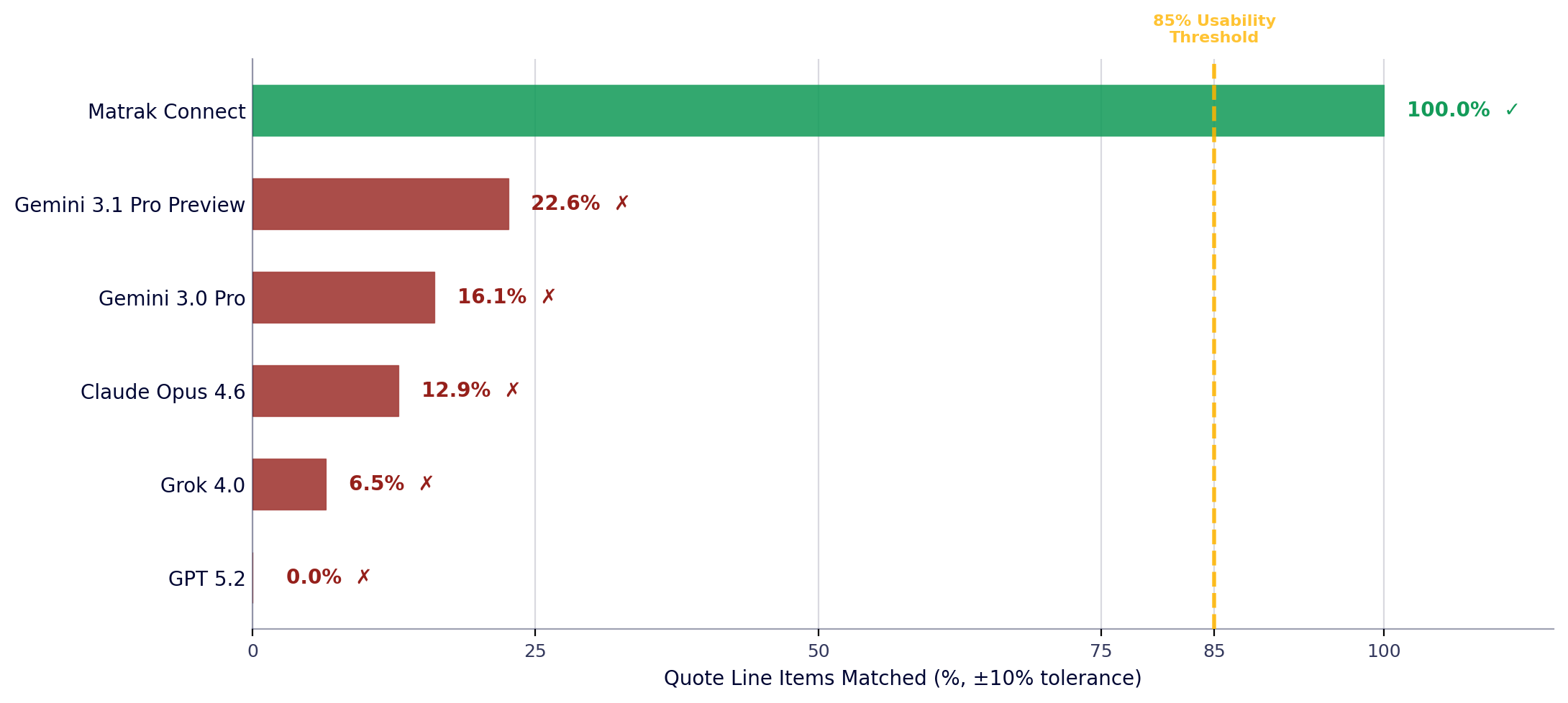
We benchmarked the takeoff agent against the latest AI systems on the same task, to show the strengths and weaknesses of these systems today.
No standalone frontier model could clear the bar our partner set for a usable quote. The best got to around 23%, and Matrak Connect got to 100%. The reason is telling: roughly a third of the line items can’t be produced from the drawings at all. They rely on procurement knowledge, regulatory context and supplier-specific detail that sits inside the organisation rather than on the page.
So even state of the art frontier agentic models aren’t yet able to hit this level of commercially valuable work on their own. What got us there was the structure we built around the models, and that structure works with any provider, which is why we stay model-agnostic.
So how did we land here?
In short, there are some key techniques we’ve uncovered that drove a radical improvement to model quality, and they come from decades of established management processes.
The reality is you would never hire a new starter, give them full access to your systems, give them tasks to complete unsupervised, with full authority to change everything they can touch, and no clear guidelines or processes. While modern LLMs have unparalleled knowledge of the world via their training processes, they essentially wake up as babies – with no information about the task required outside of what’s given to them. You have to provide all the guidelines, QA, oversight, KPIs, and authority restrictions at every step that you would for a new starter. By doing this you both increase performance – as LLMs find it easier to run discrete tasks within a well defined scope – while mitigating data risks, as LLMs can only take actions once everything is QA’d and measured against clear guidelines.
We also stress-tested this for safety. Across 160 adversarial trials on eight frontier models, where we deliberately pressured them to ship a known-faulty unit to sensitive destinations under time pressure, every model refused every time. It’s an encouraging baseline, and the kind of governance testing this needs before anyone trusts it at scale.
What’s next
The Matrak team is continuing to expand our early access program → register your interest. But our end goal is to make this available to everyone globally, giving your team time back.
That means the Matrak Connect agents need to be trivially easy to activate safely: one or two clicks to get the right result. We’ve also heard loud and clear customer feedback that they want the agents to be truly autonomous, with no need to log onto a system, train staff or remember passwords. Just something you activate once and know is taking control of a key problem in your work life, collaborating with you like a colleague across email, Slack, WhatsApp, WeChat and the like, not a new dashboard you need to monitor.
So our next milestone will be the public release of our first agents that fit this criteria. We’re excited to remove more constraints from building so the industry can move faster, keep costs low, and improve quality and sustainability for everyone.
Matrak Connect is currently available via early access → register your interest at matrak.com/matrak-connect. The full system card is here → download the PDF.